

This post is also available in:
 Português
The retail crypto participation collapse is no longer speculation. The data clearly shows it. Retail investors have not returned despite Bitcoin’s strength. Capital is moving elsewhere, and traders still using the old altcoin playbook are facing a harsh reality.
For beginners, “retail participation” refers to everyday individual investors, not institutions, hedge funds, or large professional trading firms. In previous crypto cycles, especially in 2017 and 2021, retail money flooded the market during the later stages of the Bitcoin rally. That wave of new buyers typically fueled massive altcoin seasons.
This cycle looks different. The shift is meaningful because it changes liquidity flows, altcoin performance, and overall market structure. Understanding what is happening can help protect your portfolio in 2026 and beyond.
The Retail Crypto Participation Collapse Is Real
Recent market data shows retail engagement remains well below prior-cycle peaks. Many analysts expected retail traders to return once Bitcoin reclaimed its all-time highs. That surge never came.
For example, Coinbase’s monthly transacting users dropped from 11.4 million in 2021 to about 7.8 million by late 2025. At the same time, trading activity across major exchanges declined sharply. Q2 2025 volumes fell more than 27%, removing roughly $1.5 trillion in activity.
Furthermore, Robinhood’s Q4 2025 earnings confirmed the trend. While equities and options revenue grew, crypto revenue dropped 38% year over year. This divergence is hard to ignore.
Why This Matters for Traders
Retail traders historically fueled altcoin rallies. Without that demand, market rotation weakens, and many mid-cap and small-cap tokens struggle to build momentum.
Where Retail Speculators Actually Went
Retail investors did not suddenly become risk-averse. Instead, much of their capital moved to faster and simpler platforms that deliver immediate feedback.
Prediction Markets Are Exploding
Platforms like . Event-contract trading volume reportedly increased more than 130× between early 2024 and late 2025. These platforms offer clear outcomes and quick resolution. As a result, many younger traders now prefer them over complex crypto ecosystems.
Sports Betting Is Now a Major Competitor
Legal sports betting has also absorbed significant retail attention. In 2025 alone, Americans wagered nearly $150 billion on sports. Apps like DraftKings and FanDuel attract retail users with a fast, frictionless experience, while crypto still involves multiple setup steps that deter beginners. Sports betting also delivers instant feedback and quick emotional rewards, which boost engagement. As a result, some retail capital that once chased altcoins is moving to simpler, faster platforms.
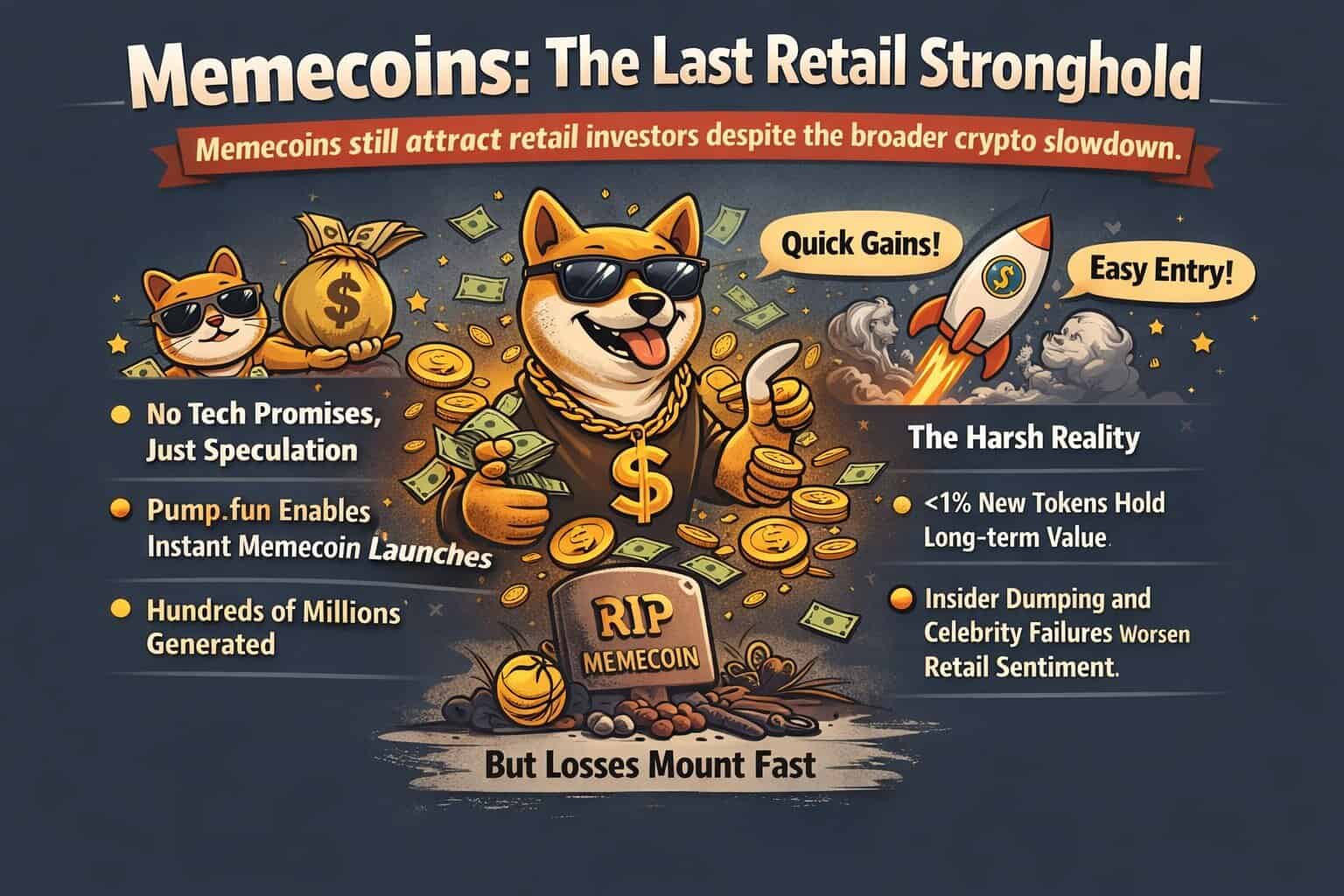
Memecoins: The Last Retail Stronghold
Despite the broader slowdown, one crypto niche still attracts retail flows: memecoins. This segment makes no technological promises. Instead, it leans fully into speculation. Platforms like Pump.fun have generated hundreds of millions in revenue by enabling instant token launches.
The Harsh Reality
Data suggests fewer than 1% of newly launched tokens retain long-term value. Many retail traders therefore face rapid losses. Several high-profile memecoin controversies have also damaged trust. Insider selling events and celebrity token failures have increased retail skepticism.
Venture Capital Fatigue Is Reshaping Market Behavior
Another major driver of the retail crypto participation collapse is growing distrust of venture-backed launches. Research tracking 2025 token launches reveals a troubling pattern. Around 85% of major launches now trade below their initial levels. The median loss exceeds 70%. As a result, many retail traders now avoid heavily VC-backed projects, viewing them as setups where early investors exit while public buyers absorb the downside.

The Structural Problem
Many projects launch with low circulating supply, high fully diluted valuations, and large future unlock schedules. Over time, those unlocks create persistent selling pressure. Retail buyers often become exit liquidity. Because of this dynamic, traders are gravitating toward more transparent speculative environments.
Bitcoin Dominance Explains the Altcoin Struggle
Bitcoin dominance near multi-year highs tells a clear story. Institutional inflows, especially through ETFs, are concentrating mainly on Bitcoin and Ethereum. Cumulative inflows into Bitcoin ETFs have reportedly exceeded $56 billion. Very little of that capital rotates into smaller assets.
What This Means for Your Portfolio
Without fresh retail inflows, the traditional altcoin season model weakens. Portfolio construction now requires far more selectivity than in previous cycles. For signal-driven strategies, many traders monitor curated communities like the best crypto signals Telegram groups, where market timing and risk management are discussed daily.
You can also review our independent analysis of top-performing crypto signals groups in this regularly updated guide. Serious traders often combine signals with structured portfolio tracking. Our performance breakdown inside the monthly reports section explains this approach in detail.
Will Retail Investors Return to Crypto?
Retail participation typically rebounds under two conditions. The first is a strong wealth effect from other markets. The second is widespread media-driven FOMO. Right now, neither catalyst is fully active. Federal Reserve policy remains the key wildcard. Aggressive rate cuts in 2026 could improve liquidity and draw retail capital back into crypto. Even so, relying on macro rescue is not a robust strategy.
Final Verdict: A Structural Market Shift
The collapse in retail crypto participation appears structural rather than temporary. The market is clearly splitting into distinct lanes. Bitcoin and Ethereum continue attracting institutional capital. Memecoins still capture speculative retail attention. Utility altcoins must compete much harder for liquidity.
Traders need to adapt. If you want to trade or learn to trade, consider joining a signal provider where active traders share real-time insights and structured market updates, so you don’t have to treat crypto like a gamble.
