

This post is also available in:
 Português
As of January 1, 2026, EU crypto privacy ends under DAC8 across all member states. DAC8 is the latest EU tax cooperation law, extending automatic reporting rules directly into crypto markets. It amends existing tax cooperation frameworks so digital assets now fall under the same transparency logic as traditional fin
For years, crypto promised autonomy and discretion, especially when compared to banks. Under DAC8, exchanges and service providers must now share user data with tax authorities automatically. This shift replaces informal visibility with structured, continuous oversight that operates across borders without user involvement.
Official EU legal text (EUR‑Lex)
European Commission DAC8 overview
What EU Crypto Privacy Ends Under DAC8 Really Means
EU Crypto Privacy Ends Under DAC8 because tax cooperation rules now fully include digital assets in scope. Reporting was once fragmented across jurisdictions and platforms. DAC8 replaces that patchwork with unified standards shared automatically between EU tax authorities.
The directive expands the EU framework for administrative cooperation in taxation. Crypto platforms must now report defined user data directly to national authorities, using standardized formats. This includes identity data, account details, and transaction information relevant for taxation.
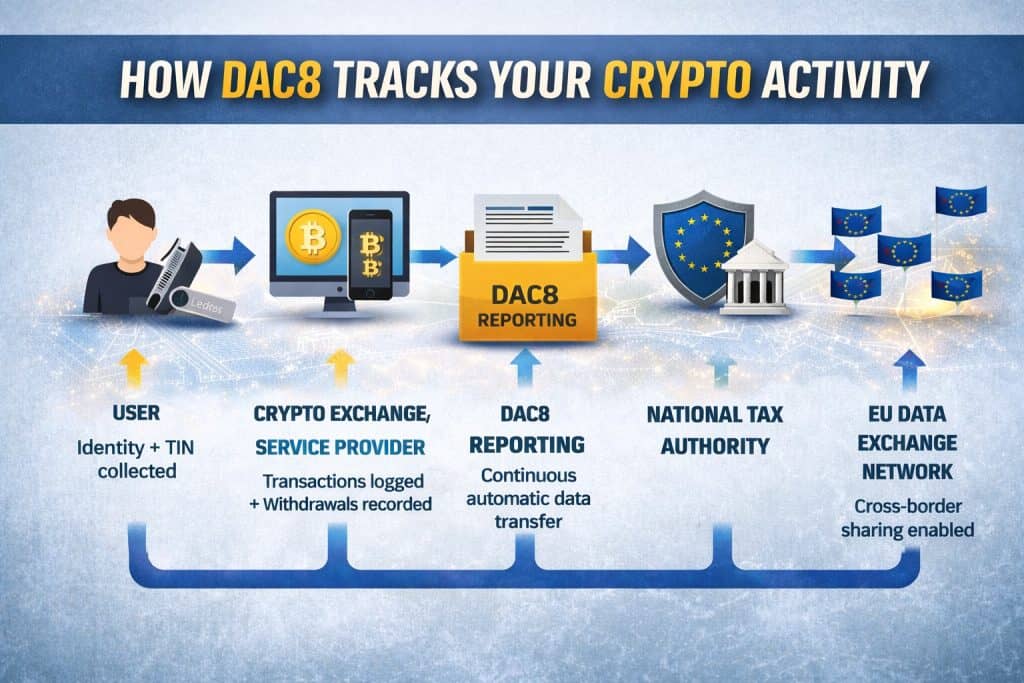
This obligation applies to exchanges based in Europe and custodial platforms licensed under EU rules. It also applies to platforms outside the EU that actively serve European residents. Location of headquarters no longer determines reporting exposure.
Automatic Reporting Changes Everything
Under DAC8, platforms must collect verified identity information at the account level. This includes names, addresses, and Tax Identification Numbers. However, these details are no longer optional for continued access to regulated services.
Platforms must also submit transaction histories covering relevant activity during the tax year. As a result, tax authorities receive these records through automatic exchanges, not manual requests. This removes delays and reduces reliance on audits.
The reporting scope includes crypto‑to‑fiat transactions and conversions. It also includes crypto‑to‑crypto trades executed on compliant platforms. In practice, most trading activity now falls inside the reporting perimeter. Historical activity becomes easier to reconstruct as datasets accumulate. Even when assets move later, the initial transaction record remains available. Time no longer erases exposure created at regulated entry points.
Crypto Privacy Before and After DAC8
| Aspect | Before DAC8 | After DAC8 |
|---|---|---|
| Exchange reporting | Limited, inconsistent | Automatic, standardized |
| TIN requirement | Often optional | Mandatory |
| Crypto-to-crypto trades | Rarely reported | Reported |
| Withdrawals to wallets | Weak visibility | Recorded |
| Cross-border sharing | Fragmented | Automated EU-wide |
Private Wallets Lose Practical Anonymity in EU Crypto Privacy
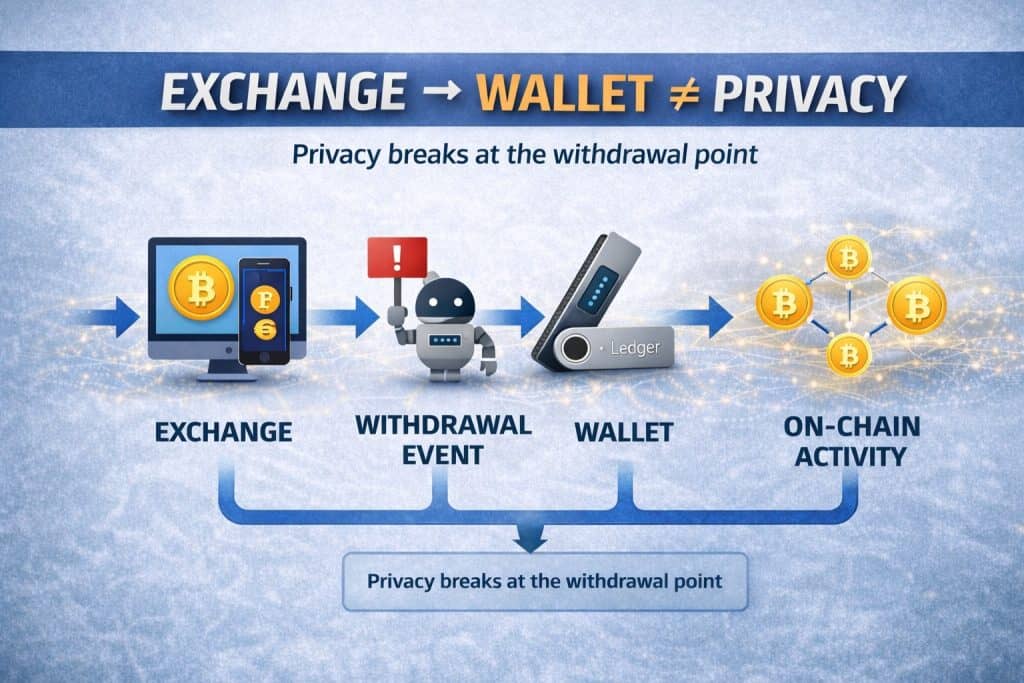
Many users believed self‑custody guaranteed privacy by default. In practice, EU Crypto Privacy Ends Under DAC8 at the exchange boundary, not on-chain. The critical moment is the withdrawal from a regulated platform.
When assets move from exchanges to hardware wallets, the withdrawal is recorded. Consequently, that single event can link identities to on‑chain addresses. From there, transaction patterns can be analyzed over time.
The wallet itself remains private and under user control. However, the monitored bridge between custody and self‑custody creates lasting attribution risk. Privacy depends on how that bridge is used.
Compliance Is Enforced, Not Optional
DAC8 obligates platforms to verify user identities on an ongoing basis. Missing or invalid data triggers restrictions on functionality. In practice, this includes trading limits or withdrawal blocks.
In many cases, accounts may be frozen until compliance is completed. Anonymity cannot be preserved on regulated platforms once reporting thresholds apply. Service providers are legally bound to enforce these rules.
This obligation is legal, not discretionary. It’s embedded directly in EU law. Platforms face penalties if they fail to enforce reporting standards. Enforcement pressure applies to both compliance teams and technical infrastructure.
Non‑EU Exchanges Are Not Safe Havens
Some users consider non-European platforms as alternatives to EU regulation. DAC8 directly addresses this behavior by extending obligations beyond EU borders.
Non‑EU providers serving EU residents must comply with reporting rules. Non‑compliance risks exclusion from the European market, including payment restrictions and access blocks.
Over time, this extends EU regulatory influence beyond borders. As a result, access for EU users increasingly aligns with EU standards, regardless of the platform’s location.
Tax Authorities Now Operate With Automation
DAC8 shifts enforcement from manual information requests to automated data flows. Authorities receive standardized datasets regularly without initiating contact.
Systems compare reported activity with tax filings at scale. Discrepancies are flagged through routine analysis rather than targeted investigations. This automation reduces subjective enforcement decisions. Moreover, it also increases consistency across member states, limiting regulatory arbitrage within the EU.
What Still Retains Limited Privacy
Self‑custody without exchange interaction can still offer partial privacy in limited scenarios. Entry and exit points remain the primary vulnerability for most users.
Peer‑to‑peer transfers avoid direct platform reporting. However, operational mistakes accumulate over time, especially when funds re‑enter regulated systems. Eventually, many users interact with banks or exchanges for liquidity. Therefore, complete isolation is rarely sustainable long‑term under current economic conditions.
- For practical guidance, see our overview on choosing the best crypto wallets for security, cost, and coin support.
- For tax planning context, review our crypto taxation guide.
Final Warning about the EU Crypto Privacy
EU Crypto Privacy Ends Under DAC8 for all regulated activity across Europe. This shift is structural, permanent, and deeply embedded into how financial oversight now operates within the Union.
What once depended on audits, disclosures, or enforcement actions now happens automatically through reporting systems. As a result, crypto activity increasingly resembles traditional finance from a compliance perspective.
Users must update assumptions about privacy, anonymity, and long-term exposure. Strategic planning now matters more than ideology in regulated crypto markets. Understanding reporting boundaries, custody choices, and compliance obligations is no longer optional for serious participants.
