

This post is also available in:
 Português
Crypto struggled through much of 2025; however, one sector quietly delivered exceptional performance: prediction markets. Prediction markets now sit at the crossroads of crypto innovation, speculation, and ethics. This article examines where growth turns into risk. These platforms expanded rapidly, yet that same speed introduced new structural risks. Meanwhile, liquidity fragmentation and ethical controversy intensified across the sector. Investors are now asking harder questions. Are prediction markets a durable financial innovation, or a fragile trend nearing exhaustion? This article explains their origins, mechanics, risks, and profit dynamics. More importantly, it exposes where the real threats may emerge next.

What Prediction Markets Really Are
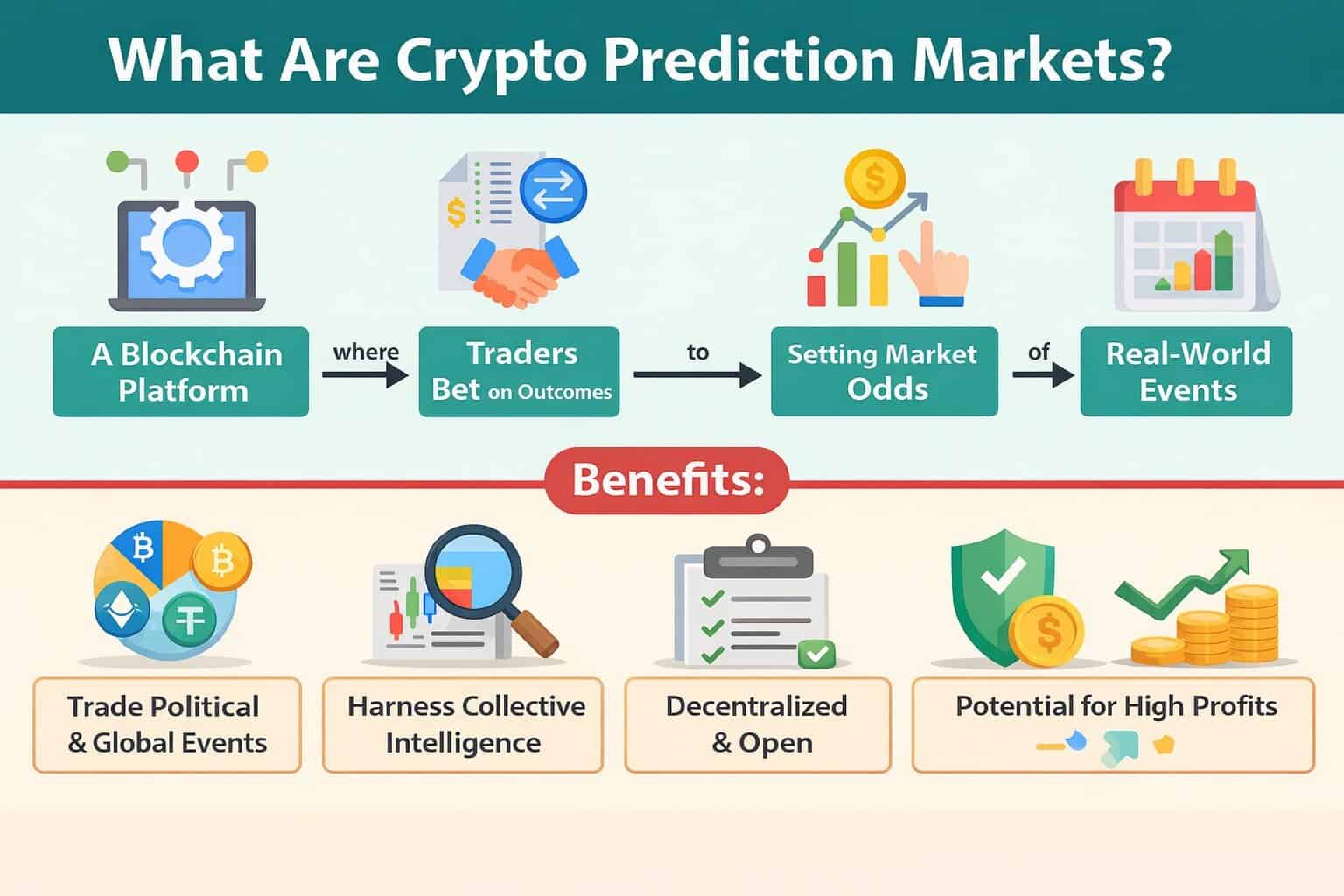
A prediction market is a trading venue focused on future outcomes rather than asset prices. Traders buy and sell probability itself instead of tokens or stocks. These events span politics, economics, culture, and sports. For example, participants speculate on elections, policy changes, or product launches. Most markets use binary contracts with “Yes” or “ No” outcomes. Each contract trades between $0 and $1 before settlement.
A “Yes” price of $0.63 implies a 63% probability. Therefore, prices act as real-time odds. If the outcome resolves as true, the contract settles at $1. When the outcome resolves correctly, the contract settles at $1, and the difference becomes profit. However, prices shift continuously before resolution, which allows traders to profit from changing expectations rather than waiting for final outcomes. Because many participants contribute information, prediction markets often sharpen forecasts and occasionally outperform traditional polling.
Why Prediction Markets Can Be Uncomfortably Accurate
Polls capture opinions, while prediction markets capture conviction backed by capital. Money forces participants to weigh information carefully. When new data appears, traders reposition quickly, and prices adjust almost instantly. This responsiveness can make prediction markets faster than traditional indicators. Accuracy still depends on liquidity and incentives. Thin markets can exaggerate probabilities, while deep markets tend to converge on realistic expectations. This dynamic explains why journalists, analysts, and researchers increasingly monitor prediction markets as early signals.
Prediction Markets Are Older Than They Appear
Prediction markets feel modern; however, the idea itself is ancient. For thousands of years, people have wagered on uncertain outcomes, from wars and races to political leadership. Ancient societies bet on wars, races, and political shifts. Later, informal markets appeared in financial circles and newspapers that once printed odds alongside market commentary. The transition to online platforms in the 1990s expanded participation and improved pricing. As markets grew, regulatory attention followed, setting the stage for today’s legal debates.
The Regulatory Turning Point That Changed Everything
In the United States, regulators have often treated prediction markets as a form of gambling, leaving them in a legal gray zone. Some platforms were shut down or restricted, while others survived through narrow exemptions. All of these platforms can assist with more people getting addicted to gambling without oversight. Court challenges eventually reshaped this interpretation. Restrictions on certain election-related contracts were relaxed, thereby facilitating renewed growth. Regulation remains fragmented, though, and jurisdictional risk still varies widely.
Why Crypto Supercharged Prediction Markets
Traditional prediction markets rely on centralized infrastructure, payment processors, and intermediaries. These dependencies limit access and create friction. Crypto removed many of those barriers by enabling transparent settlement and global participation through wallets. Blockchains also make market data auditable, which improves trust and accountability. Transparency alone does not solve every issue, but it reduces some manipulation risks and expands who can participate.
The First Wave of Crypto Prediction Markets
Early crypto prediction markets emerged on Ethereum. For example, Augur launched in 2014. Augur later went live in 2018. However, adoption remained limited. Usability challenges slowed growth. Meanwhile, reputational issues accumulated. Gnosis entered the sector in 2015. It developed conditional token frameworks for complex outcomes. Those tools later powered Omen. As a result, decentralized markets became more practical. Still, mainstream adoption lagged. So the sector waited for a true breakthrough.
Polymarket Triggered the Breakout Moment
In 2020, Polymarket launched and gained traction by combining low-cost infrastructure with a simple market design. Initially, it leveraged low-cost blockchain infrastructure. Election cycles then drew massive attention, and trading volumes expanded rapidly. Regulators challenged parts of the model. As a result, access changed for some users. Yet international growth continued, and venture funding accelerated. Liquidity surged during the 2024 election cycle, followed by heavy profit-taking. Activity later stabilized, leaving Polymarket as a benchmark for the sector.
| Platform | Blockchain | Primary Focus | Liquidity | Key Risk |
|---|---|---|---|---|
| Polymarket | Polygon | Politics, real-world events | High | Regulation |
| Augur | Ethereum | General outcomes | Low | Adoption |
| Omen | Ethereum | DeFi-linked events | Medium | UX complexity |
| Centralized platforms | Off-chain | Sports, politics | High | Custodial risk |
Oversaturation and Fragmented Liquidity
Success attracts imitators. New platforms continue to launch, which fragments liquidity across venues. Fragmentation widens spreads and weakens pricing quality. Low-volume markets also invite aggressive positioning, making probabilities easier to distort. In extreme cases, narratives can overpower fundamentals and influence perception rather than reflect reality.
Key Risks Every Trader Should Understand
- Low-liquidity distortion
- Regulatory whiplash
- Insider information asymmetry
- Narrative manipulation
- Moral hazard around sensitive events
Ethical Risks That Cannot Be Ignored
Many controversies originate with users rather than platforms. Markets tied to sensitive events raise moral concerns and public backlash. The core fear is straightforward. When profits depend on harmful outcomes, incentives can become misaligned. Even when platforms do not create these markets, public perception still matters. Therefore, safeguards are becoming unavoidable. Ethics also intersects with legality, thereby increasing the likelihood of tighter safeguards and regulatory intervention.
Insider Information and Uneven Playing Fields
Prediction markets reward insight, but that insight can resemble inside information. Sudden probability shifts often raise suspicion and erode trust. Even without proof, perception damages credibility. Enforcement remains difficult across pseudonymous wallets, which keeps pressure on platforms and regulators to improve monitoring standards.
Market Makers and Conflicts of Interest
Liquidity improves trading conditions, which explains why platforms rely on market makers. Some operators also use internal trading desks, raising concerns about conflicts of interest. Supporters argue this approach stabilizes markets, while critics fear asymmetric advantages. This debate will intensify as volumes increase and expectations for transparency rise.
Are Prediction Markets Here to Stay?
Yes, momentum appears durable. However, evolution will be turbulent. Major platforms are integrating into crypto infrastructure, reinforcing broader crypto market trends. Coinbase is expanding event-market exposure. Wallets like Phantom improve discovery. Therefore, access continues to improve. Institutions are also experimenting, often supported by professional market analysis. So event contracts may become hedging tools. Aggregators may eventually dominate user behavior, while regulation continues shaping outcomes.
How Traders Attempt to Profit
Several strategies exist. However, none are guaranteed. Exploit mispriced probabilities. If odds lag reality, traders may profit. Therefore, research becomes critical, alongside strong risk management. Others trade sentiment shifts around news events or cautiously target high-probability contracts. Some participants focus on platform incentives and early participation. Position sizing remains the most important safeguard.
Prediction markets are best for:
- Traders who follow macro, politics, or regulation
- Analysts who spot narrative shifts early
- Investors hedging real-world risks
They are not ideal for:
- Beginners without risk management
- Traders chasing fast leverage
- Anyone treating probabilities as certainty
Key Takeaways
Prediction markets trade probability using real capital, which explains their forecasting power. Crypto expanded access and participation across modern crypto trading platforms. At the same time, oversaturation threatens the quality of liquidity. Ethics and regulation remain unresolved pressure points, even as the sector shows long-term potential.
Final Word
Prediction markets are powerful tools with sharp edges. They can surface hidden information while simultaneously amplifying narratives. Selectivity, skepticism, and risk awareness separate opportunity from regret.
Frequently Asked Questions About Crypto Prediction Markets
A crypto prediction market lets users trade probabilities on future events using blockchain-based contracts
Legality depends on jurisdiction, because regulation varies widely across countries and states.
They resemble gambling, but legally, they are often classified as event-based financial contracts.
They aggregate collective intelligence, and traders risk real money, which sharpens incentives.
Polymarket is widely used, but users must understand regulatory limits and trading risks.
If you just want help trading, join one of the crypto signals groups that we reviewed.
